
Design system vs. brand identity: what's the difference and why you need both
Most founders confuse brand identity with design system. One is the soul of your company. The other is the infrastructure that scales it. Here's why you need both — and in what order.

Most founders treat these two things as the same. They're not. And confusing them is one of the most expensive mistakes you can make when your company starts to scale.
Let's cut through the jargon.
Brand identity is the soul. Design system is the skeleton.
Your brand identity is what makes your company feel like something. It's the logo. The colors. The typeface. The tone of voice. The personality behind every touchpoint — your pitch deck, your Instagram, your website header. It answers one question: who are you?
A design system is how you make sure that "who you are" shows up consistently, at scale, across every surface your product or company touches. It's a library of reusable components — buttons, cards, forms, spacing rules, color tokens — built on top of your brand's visual language, translated into something engineers and designers can actually ship.
Brand identity without a design system is a house with a beautiful façade and no structural walls. It looks great until someone tries to build a second floor.
Design system without brand identity is a house with great infrastructure and no soul. Functional. Forgettable.
Why founders mix them up
The confusion is understandable. Both involve colors, typography, and logos. Both live in Figma. Both show up when you onboard a new designer or brief an agency.
But they serve completely different purposes — and they're built for different audiences.
Your brand identity is for everyone: investors, customers, your marketing team, the agency you hire to run your campaigns. It's the rule book — it says "our blue is #0A2FFF, and this is the only context in which you use it."
Your design system is for your product team: designers, developers, product managers. It's the toolkit — it says "here's a button component in three states, with the right color token baked in, ready to drop into any screen."
One governs communication. The other governs production.
As The Design Systems Collective puts it, brand guidelines are "emotional, expressive, and timeless" while design systems are "practical, structured, and functional." Same visual DNA. Different environments.
The order matters more than you think
Here's the mistake I see constantly with founders who are starting to invest in their image: they want to "build a design system" before they've sorted their brand identity.
That's like trying to write the recipe before you know what dish you're cooking.
Metabrand's startup branding guide is blunt about this: "The mistake most startups make is jumping straight to identity without doing the strategy work first. A logo designed without positioning is just decoration."
The right order:
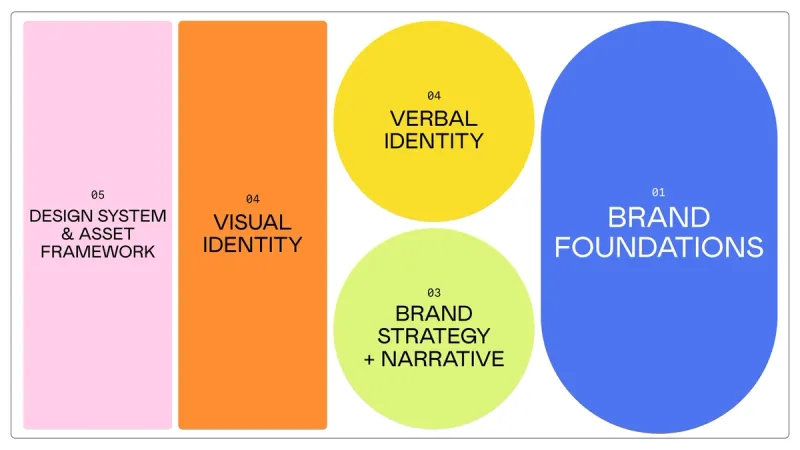
- Brand strategy — who you are, who you're for, what you stand for
- Brand identity — the visual translation of that strategy (logo, colors, typography, tone)
- Design system — the scalable infrastructure built on top of that identity
Skip step 1 and step 2 breaks. Skip step 2 and step 3 has nothing to build on.
What brand identity actually includes
A solid brand identity for a tech company at your stage covers:
- Logo system — primary logo, secondary mark, favicon, rules for minimum size and clear space
- Color palette — primary, secondary, and functional colors with exact hex values (and CMYK if you ever print anything)
- Typography — headline and body typefaces, sizing hierarchy, weight rules
- Imagery style — what kind of photography, illustration, or iconography fits the brand
- Brand voice — tone, vocabulary, what you say and what you don't
According to Spellbrand's brand identity guide, without this system, "brands drift. Marketing teams improvise. Designers guess. Customers see something different every time they interact with you."
That inconsistency is invisible when you're five people. It becomes a real problem when you're fifty.
What a design system actually includes
A design system takes the foundations above and extends them into something engineers can ship:
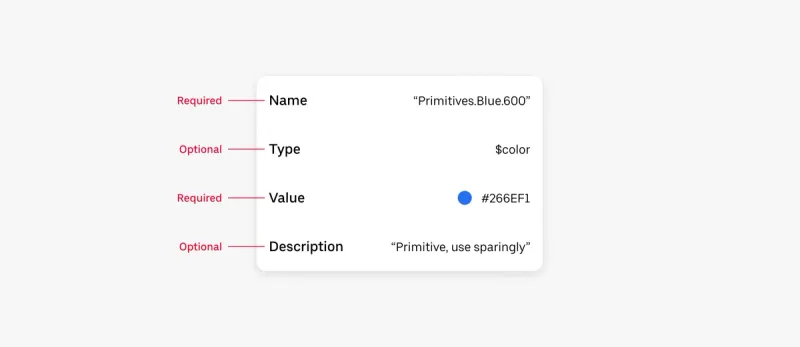
- Design tokens — your colors, spacing, and typography translated into variables (--color-primary, --spacing-md) that work across code and design files
- Component library — buttons, inputs, cards, modals, navigation patterns, all built with the brand's visual rules baked in
- Usage documentation — when to use what, what states exist, what to do in edge cases
- Code snippets — ready-to-use implementations, not just visual specs
Superside's research shows designers with a design system complete tasks 34% faster — equivalent to 3.5 full-time designers per week. And 85% of marketers say vendors misapply brand identity when there's no centralized system in place.
That's the hidden cost of not having one.
The moment you actually need a design system
Not every company needs a full design system on day one. A seed-stage startup can get away with brand identity guidelines and a simple component library in Figma.
But the signals that you need to level up are clear:
- You have more than two designers working on the same product
- Your marketing team and your product team are producing visuals that look like they're from different companies
- You're onboarding a new agency or freelancer every few months and spending the first week re-explaining your brand
- Your website and your app feel like two different brands
At that point, the absence of a design system is no longer a design problem. It's a business problem. Every off-brand asset erodes trust. Every inconsistency adds a tiny tax to every customer interaction. Real world: how the best brands handle both
The companies that get this right don't treat brand identity and design system as separate projects. They build them as a layered system.
Airbnb's Cereal typeface and color system live in both their brand guidelines and their design system — the same token, expressed differently depending on who's consuming it. The brand team talks about emotional warmth. The product team talks about color.primary.500. Same blue. Different vocabulary.
Mailchimp's design system reflects their brand personality directly — the playful illustrations, the humor in microcopy, the bold color usage. The system doesn't flatten the brand. It carries it into every interface.
This is the goal: brand identity sets the emotional foundation. The design system carries it through digital life, consistently, at any scale.
What this means for you
If you're a founder whose company is generating revenue and you're starting to think seriously about your image — here's how to think about the investment:
Brand identity first. This is what you need to look credible, attract the right clients, and stop losing deals because your visual presence doesn't match the quality of what you actually deliver.
Design system when you scale. Once you have a product team, more than a couple of designers, or a marketing operation producing volume — that's when systematizing the identity pays off.
The two aren't alternatives. They're a sequence. And the sequence matters.
Your company is growing. Your brand should too — but in the right order.
See my branding services